
SmartShunt settings, made understandable.
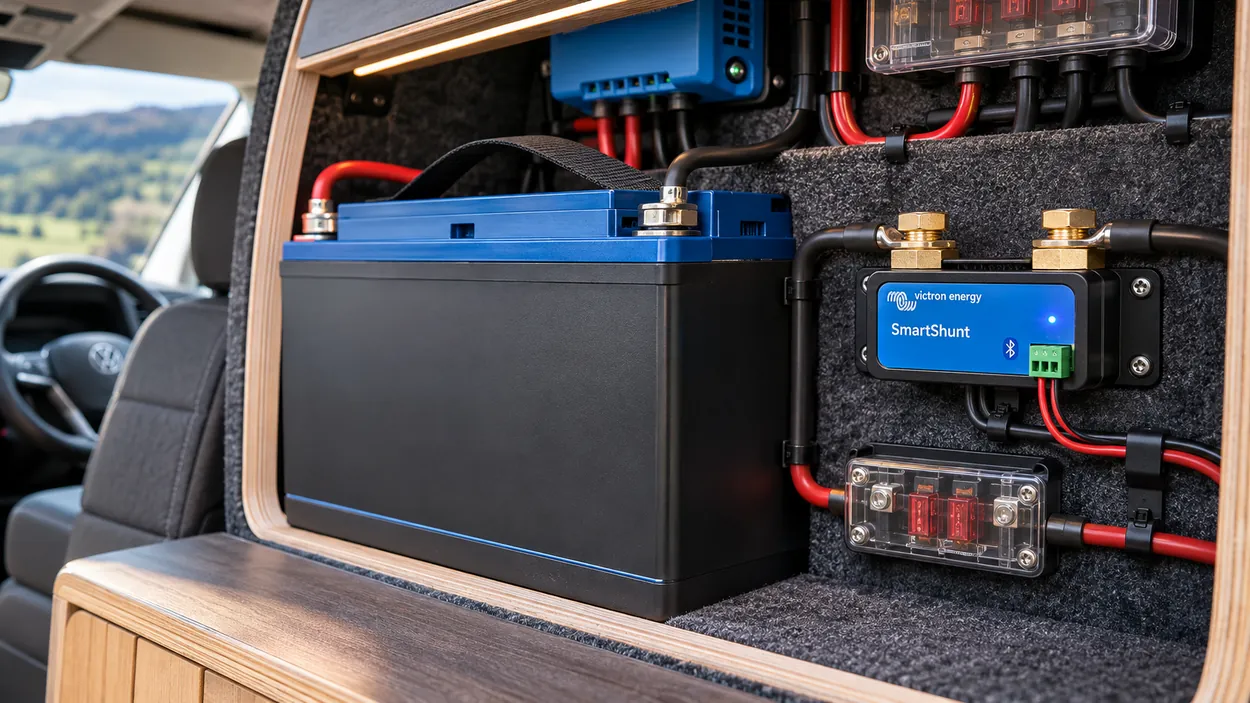
An accessible reference for a 105Ah Fogstar Drift LiFePO₄ battery monitored by Victron SmartShunt. These are starting points—not a claim to have checked your installed configuration.
105Ah lithium monitor setup
| SmartShunt setting | Starting value |
|---|---|
| Battery capacity | 105Ah |
| Charged voltage | 13.9V initially |
| Tail current | 4% (4.2A) |
| Charged detection time | 3 minutes |
| Peukert exponent | 1.01 |
| Charge efficiency | 98% |
| Discharge floor | 10% practical reserve |
The battery's actual required charger absorption/float voltages are separate settings. Victron and Fogstar guidance may differ for some monitoring parameters; check the exact model and firmware.
Don't confuse two voltages: “Charged voltage” on the shunt is a full-charge detection threshold. “Absorption voltage” on your SmartSolar or other charger actually controls charging.
The rule of the negative cable.
Where current must pass
All relevant charging and discharging negative returns must cross the shunt. The positive sense cable must also be correctly fused and routed to the battery positive as Victron specifies.
What not to do
Connecting a fridge or DC-DC negative directly to battery negative can bypass the shunt and cause erroneous state-of-charge calculations.
Disconnect and isolate safely before any wiring work. Battery cabling can deliver dangerous fault currents; correct terminals, fusing, torque and cable sizing depend on the actual installation.
Open the full explanation ↗When the readings tell porkies.
Why does the SmartShunt show 100% too early?
The monitor may have synchronised prematurely. Review charged-voltage threshold, tail current and charged detection time. A displayed 100% is calculated and should only be trusted after proper full-charge detection.
Why is SOC different from the Fogstar Bluetooth BMS?
They use different measurement systems and algorithms. Differences are possible after partial cycles or after an extended period without synchronisation. Re-check after a genuine full charge.
Why is the battery discharging while solar is generating power?
The fridge, lights and other loads may exceed the solar current. The shunt shows net battery current; the MPPT controller reports solar-side output.
Why does “time to go” jump around?
It is a projection based on current usage patterns and your configured discharge floor. Cycling loads and variable solar cause the estimate to change.
Why does the shunt show no discharge current?
Either there is little or no current, or some loads are bypassing the measurement path. Check the system under a known load and inspect the installation against the manufacturer's wiring guide.
How do I know if the battery is healthy?
SmartShunt history is useful, but state of charge is not a full capacity test or a direct diagnosis of lithium cell health. Battery BMS reports and controlled testing may be needed.