
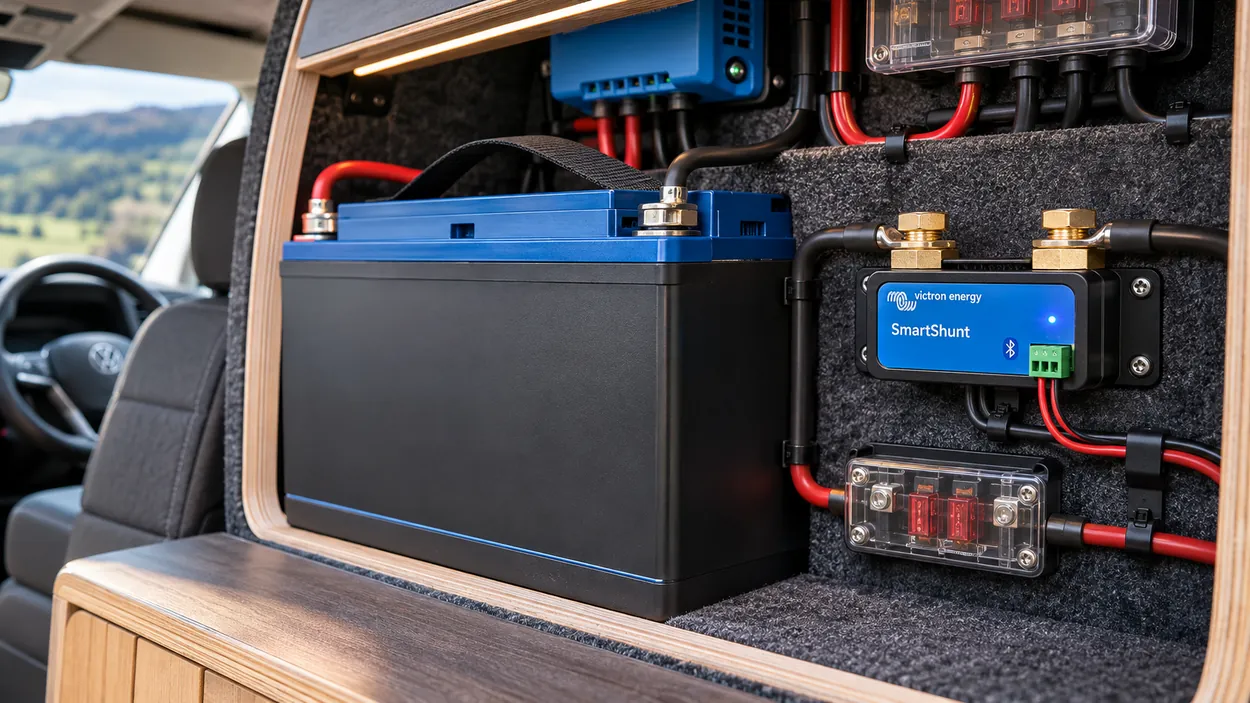
The fuel tank is now made of lithium
The leisure battery inside Vanilla is a Fogstar Drift 105Ah LiFePO₄, installed in October 2026 in place of the older AGM battery. This is not simply a larger version of a traditional lead-acid unit. Its chemistry, charging behaviour, discharge characteristics and built-in protection system are different.
LiFePO₄ stands for lithium iron phosphate. It is widely used in leisure electrical systems because it can deliver a useful proportion of its rated capacity, tolerates cycling well under appropriate conditions and maintains a relatively stable voltage through much of its discharge. The advantages are valuable—but the associated settings and safety instructions are not optional.
Ah, Wh and the energy that actually matters
Battery capacity is commonly quoted in amp-hours, such as 105Ah. That is a quantity of electrical charge, not a watt-hour energy rating by itself. For a useful approximate conversion, multiply by nominal voltage.
105Ah × 12.8V ≈ 1,344Wh, or roughly 1.34kWh of theoretical nominal energy. That is an educational calculation, not a measurement of Vanilla's present usable energy. The battery's manufacturer may specify its rated energy differently, and practical use is affected by limits, internal losses, state of health, temperature and discharge cutoff.
A 30W device used for ten hours consumes approximately 300Wh (not counting conversion and standby losses). On a nominal 12.8V basis that is approximately 23.4Ah. The battery has enough capacity to serve plenty of small loads, but high-wattage equipment changes the maths quickly.
| Electrical quantity | Meaning | Example |
|---|---|---|
| Volts (V) | Electrical potential | 12.8V nominal battery |
| Amps (A) | Rate of electric current | 3A load |
| Amp-hours (Ah) | Current over time | 3A for 4h = 12Ah |
| Watts (W) | Rate of energy transfer | 12.8V × 3A ≈ 38W |
| Watt-hours (Wh) | Energy consumed or supplied | 38W for 4h ≈ 152Wh |
| SOC (%) | Estimated remaining charge | 76% estimate |
Why the lithium voltage looks so stubbornly flat
With an older lead-acid battery, open-circuit voltage gives some indication of charge when measured after a suitable rest. Lithium iron phosphate has a considerably flatter voltage-versus-SOC curve across the middle of its operating range.
A reading near 13.2V does not uniquely identify whether the battery is 90% full or closer to the middle. Charging, recent load and temperature complicate the interpretation further. That's why the SmartShunt is valuable: it accumulates measured in-and-out charge and periodically synchronises its estimate when full-charge conditions are met.
Important: The SmartShunt's SOC is an estimate, not a physical liquid-level sensor. It can drift if it is not configured or synchronised correctly.
What does the Fogstar BMS do?
BMS stands for Battery Management System. A battery-integrated BMS monitors internal electrical conditions and manages protective behaviour according to its design. It may react to excessive charge/discharge current, voltage limits and temperature conditions.
The BMS and the SmartShunt are complementary:
- The BMS is part of the battery's internal protection and management.
- The SmartShunt measures circuit current externally and estimates SOC and usage history.
- The MPPT, Orion and mains charger regulate charging according to their settings and operating constraints.
A BMS is not a substitute for correctly sized cables, suitable overcurrent protection, mechanically secure connections or good electrical design. Do not use protective shutdown as a normal daily cutoff strategy.
Is 20% a sensible lithium reserve?
For a campervan, leaving a reserve is usually useful—even when the battery chemistry permits deeper discharges. Your SmartShunt's discharge floor is primarily used to calculate time to go. It does not command the battery to stop supplying electricity when that SOC appears.
With a practical 10% reserve, a nominal 105Ah battery has approximately 94.5Ah between 100% and that reserve, before allowing for the difference between nominal and real-world performance. At 20%, that planning window becomes 84Ah. These are simplified capacity calculations, not guaranteed deliverable figures.
I favour thinking in terms of what must still work tomorrow morning: the compressor fridge, heater controls, lights and communications. A little margin prevents a pleasant trip from turning into battery management by torchlight.
Cold weather: lithium's important exception
One of the critical differences from lead-acid is low-temperature charging. Charging LiFePO₄ cells below their permitted temperature can damage them. Fogstar's Drift documentation describes built-in low-temperature charging protection and, for certain versions, self-heating pads powered by incoming charge current.
This does not mean every lithium battery can safely charge below freezing or that a warm cabin guarantees warm battery cells. Battery location, heating-pad operation, BMS configuration and exact product version matter. If the battery reports a low-temperature charge warning, respect it and consult the manufacturer.
The battery may still power loads under some low-temperature conditions when charging is restricted. The discharge and charge temperature limits are different; follow your actual battery manual.
AGM versus lithium, in a campervan context
| Topic | Traditional AGM leisure battery | LiFePO₄ leisure battery |
|---|---|---|
| Voltage behaviour | Larger voltage variation with SOC | Flatter SOC-voltage curve |
| Charging profile | Lead-acid profile and absorption behaviour | Dedicated lithium-compatible profile |
| SOC monitoring | Voltage/resting readings can provide a rough clue | Coulomb counting especially useful |
| Low-temperature charging | Different chemistry-specific considerations | Must respect lithium cold-charge limit |
| Internal protection | Often dependent on external controls | Typically integrated BMS |
| Useful capacity | Often managed conservatively for longevity | More of nominal capacity may be usable within limits |
This is a broad comparison, not a claim that lithium is inherently maintenance-free or that one battery fits every installation.
What the 888 readings say about Vanilla
During this particular recorded period, Vanilla's reported SOC reached 32.1% at 09:00 on 21 October 2026, and the last valid observation was 76.0% at 03:00 on 12 November. These figures show battery monitor behaviour—not a controlled capacity test or an independent measure of cell health.
Importantly, a battery that repeatedly reports 100% is not automatically proven healthy. A monitor can synchronise too early if its charged-voltage or tail-current thresholds are inappropriate. Conversely, an infrequent 100% reading does not automatically establish a defective battery.
Everyday LiFePO₄ care aboard Vanilla
- Configure every charger for a compatible lithium profile and verify the settings against the actual battery documentation.
- Avoid leaving a lithium system unattended with faults or persistent abnormal alarms.
- Pay attention to charging restrictions when the battery is very cold.
- Treat loose terminals, hot cables and unexplained smells as warning signs—not something to 'see how it goes'.
- Compare SmartShunt and BMS readings after a genuine full charge if they disagree.
- Inspect the historical trend; one unusual data point is a reason to investigate, not to panic.
- Keep a practical reserve for essential equipment when sleeping away from hookup.
The NIX verdict
The lithium upgrade makes more of the nominal battery bank useful and gives the off-grid system a different character. But the really satisfying part is understanding its limits: rated capacity, the role of the BMS, charging-temperature protection and the distinction between measured current and estimated SOC.
Continue: The SmartShunt guide, charging from three sources, or our off-grid power audit.
Sources: Fogstar Drift 105Ah product specifications, Fogstar Drift FAQ, Victron monitoring guidance.
105Ah battery: turn percentage into a plan
Enter a hypothetical SOC and reserve to see a simple available-capacity estimate for the Fogstar battery.
This simple calculation is not an empirical battery-capacity test and does not include temperature, ageing, current limits or SOC error.