

Campervan electrics, properly explained.
Forget the mystery of battery percentages and solar graphs. Come inside Vanilla's real system for an illustrated, interactive and occasionally surprising deep dive into off-grid electricity.
There's more to a campervan battery than a percentage.
Why can solar be producing power while the battery discharges? Why does a lithium voltage stay stubbornly flat? How did Vanilla recover from 37% to over 80% on 5 November? And why doesn't a reported 100% prove perfect battery health?
These are the questions we're going to answer—with the actual hardware aboard Vanilla, explanatory diagrams, interactive calculators, a detailed video library and the original historical data.
The difference that matters
This is an **independent educational series**, not a claim that AI images are photographs of my electrical installation. The CSV provides charge and SOC readings, but does not identify which charger supplied the power.
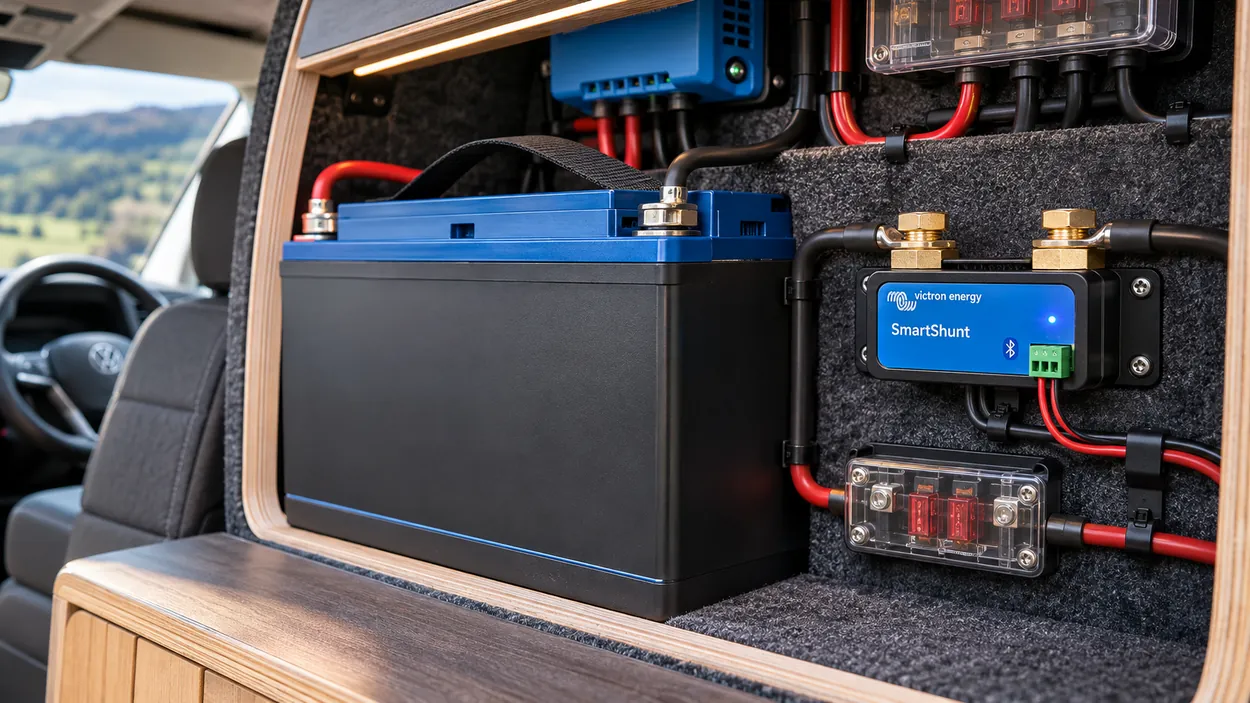
Twelve ways to get seriously good at this.
Pick a subject, follow a learning route or jump straight to the part that has been bothering you. Each chapter is written for a campervan owner, with proper engineering explanations when they matter.
The complete SmartShunt guide
Know SOC, watts, current, synchronisation and what that little blue box cannot do.
Open chapter →Solar and MPPT university
A 200W panel is not 200W guaranteed power. Learn weather, shade and net battery current.
Open chapter →Lithium, Fogstar and BMS
The battery chemistry, reserve, cold weather, capacity calculations and protection explained.
Open chapter →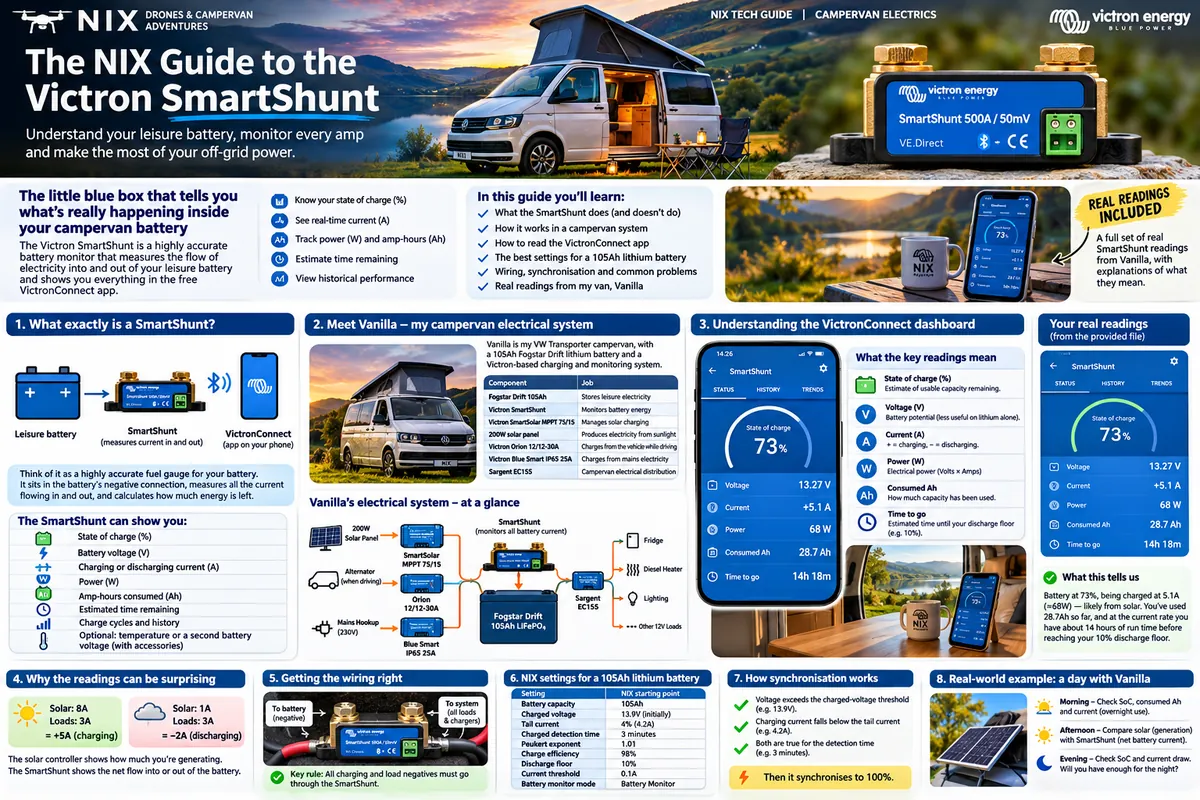
Three roads to one battery
Follow solar, driving and mains through the Victron kit, without mixing up the meters.
Open chapter →888 readings: the dashboard
A real 37-day timeline, chart filters and the 32.1% dip you need to investigate.
Open chapter →
The Vanilla Files: case studies
What happened on 20–21 October, 5 November and 11 November? Examine each event.
Open chapter →NIX Power Lab
Move the charging and load sliders. See battery net-current change in real time.
Open chapter →The overnight power audit
Calculate how a fridge, diesel heater and lights could use stored energy overnight.
Open chapter →Watch & learn
The 37-day battery animation and three selected instructional videos.
Open chapter →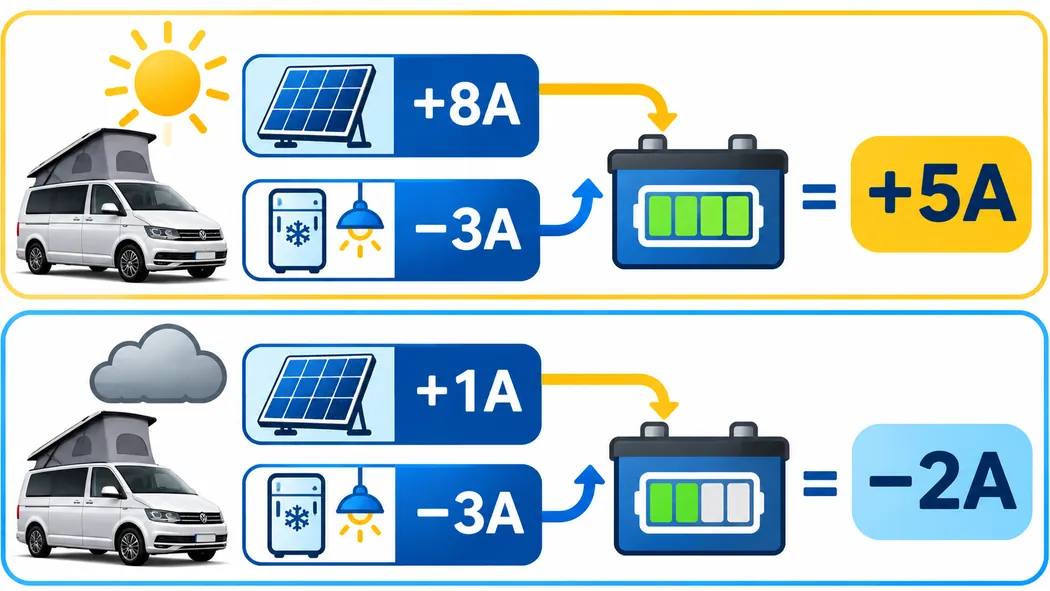
Settings and safety
Lithium monitoring values, negative-path principles, FAQs and reliable manuals.
Open chapter →The electrics dictionary
61 plain-English terms from Ah to charge efficiency.
Open chapter →Prove you know your amps
Fifteen practical questions and instant explanations. No account or tracking.
Open chapter →37 days. 888 readings. One hardworking battery.
From a low of 32.1% on 21 October to a 100% reading on 11 November, the battery log tells a story of changing charge state—not imaginary solar wattage or a fabricated battery-health score.
How low did it go?
The deepest recorded dip, followed by a rapid SOC recovery. Exactly which charger was active is not in the export.
Read case study →From 37.0% to 83.8%
A particularly clear morning-to-afternoon recovery that is ideal for explaining SOC and net battery flow.
Read case study →A return to 100%
A good opportunity to discuss what a SmartShunt synchronisation actually means.
Read case study →It's not one charger. It's an electrical ecosystem.
Sunshine passes through the SmartSolar MPPT. Driving can supply charge through the Orion DC-DC. Mains power can work through the Blue Smart IP65 charger. The SmartShunt watches what finally happens at the battery.
And because Vanilla also has a fridge, diesel heater controls, lighting and portable power stations, the net number is often more revealing than any single charging source.
Make a mistake on a slider, not a cable.
Try the Power Lab to see why net battery current changes when sun or appliances change. Then use the overnight audit to plan the energy needed by your fridge, heater electronics and lighting.
These interactive teaching models are intentionally separate from your actual live battery data. No web calculator can determine a safe battery or cable installation on its own.
Vanilla's battery life in nine seconds.
Here's the genuine historical SOC timeline condensed into a quick animation. It's a visual introduction to the long-form battery investigation, which uses the same underlying CSV.
Original NIX SOC animation · embedded locally · 6 Oct to 12 Nov 2026
Start with what you actually need to know.
Prefer to test yourself?
Try the 15-question NIX battery quiz, or search the full plain-English glossary whenever an unfamiliar term appears.