
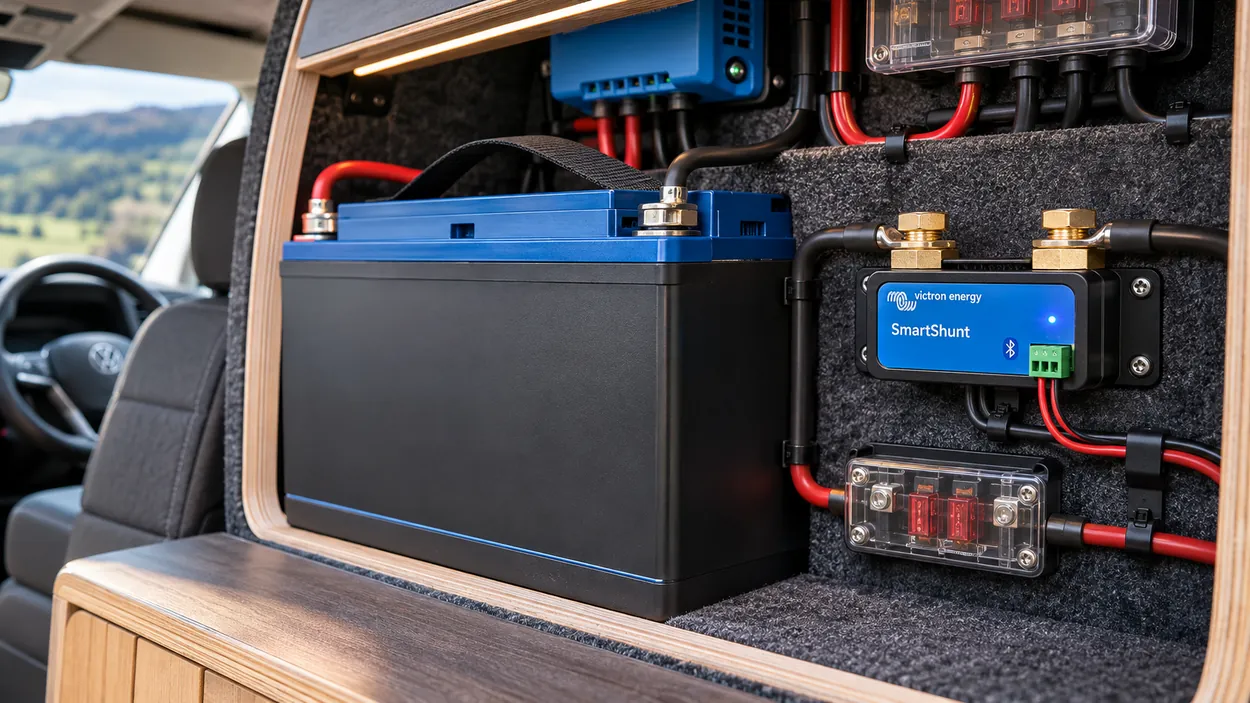
One battery, three very different ways to replenish it
Vanilla has a sophisticated little charging arrangement for a short-wheelbase Transporter. There is solar from the roof, an alternator-derived charge while travelling and a dedicated mains charger when connected to suitable 230V power. All three can replenish the same Fogstar Drift 105Ah lithium leisure battery, but the electricity reaches it via different routes and is controlled by different devices.
The useful overview is:
Sunlight → roof panel → SmartSolar MPPT 75/15 → leisure battery.
Vehicle electrical system → Victron Orion 12/12-30A DC-DC charger → leisure battery.
230V supply → Victron Blue Smart IP65 25A lithium-compatible charger → leisure battery.
The SmartShunt sits in the battery's negative return path and monitors the final net result after all correctly wired charging sources and loads are considered.
Route one: solar charging without starting the engine
The PV Logic 200W panel supplies the Victron SmartSolar 75/15. The MPPT optimises power harvesting from the panel and controls how that power is delivered to the battery. You can see its status, output and history in VictronConnect.
With a flat-mounted roof panel, midday sun is usually more favourable than low-angle sunlight, but local conditions dominate. A shaded November pitch is not the same proposition as a bright clear day in June. Solar is wonderfully quiet and automatic, but it should not be treated as a guaranteed daily refill.
When it's most useful: Daytime parking, maintaining charge while the fridge cycles and reducing dependence on other charging routes during fair-weather stops.
Route two: charging while driving
The Victron Orion 12/12-30A DC-DC is part of Vanilla's alternator-charging route. It takes energy from the vehicle electrical system and regulates an appropriate charge for the leisure battery. That is different from simply joining the starter and leisure batteries with a piece of cable.
The nameplate's 30A is a nominal charger rating, not proof that every journey provides 30A continuously. Actual operation depends on input conditions, configuration, temperature, wiring, current limits and battery charging requirements.
The engine running does not by itself guarantee a specific SmartShunt reading. The shunt can see the combined effect of charging and appliances operating simultaneously. If the fridge and other circuits are using current, net battery charging will be smaller than the charger's output.
When it's most useful: Moving between campsites, longer journeys and cloudy periods when the solar panel cannot supply enough energy.
Route three: mains charging on hookup
The Victron Blue Smart IP65 25A is Vanilla's dedicated leisure-battery charger for appropriate mains use. It is separate from the solar controller and Orion. A 25A charger has the potential to replenish a depleted 105Ah battery substantially faster than low-output winter solar, but real charging time is not simply 105 ÷ 25 because current can taper and the battery may not accept the maximum all the way to full.
Use a charger mode compatible with the battery chemistry and its manufacturer guidance. Ensure the mains supply and electrical installation meet the relevant safety standards, and never assume the Sargent control unit or other 230V circuits automatically provide the right lithium charge profile.
When it's most useful: At home before departure or on a campsite with appropriate electrical hookup.
The fourth route people sometimes overlook: portable power
Vanilla also carries Jackery portable power stations for particular appliances and off-grid jobs. They are not the same battery system as the Fogstar leisure battery.
A Jackery can run 230V equipment through its own inverter, while the Fogstar system continues supplying typical 12V campervan circuits. Where a portable station is being charged from the leisure system, that becomes another load seen by the SmartShunt if correctly wired. That can materially change the net battery result.
Important for Vanilla: There is no fixed inverter connected to the Fogstar leisure battery in the established configuration. Do not represent the 230V microwave as being powered directly by the leisure battery without an appropriate separate power source.
What happens if two charging sources operate together?
A tempting assumption is that solar, Orion and mains charger currents simply add together at their label ratings. In practice, each charger has its own voltage/current control, and the battery's actual acceptance, equipment limits, temperatures and present state affect operation. Two active chargers can interact as they reach absorption or float. Their measured currents may be less than their maxima.
More importantly, combined charge current must stay within the battery manufacturer's specifications and the limits of the electrical installation. Fogstar discusses typical charging rates of around 20–30% of capacity in its general guidance, while the exact 105Ah model's specifications must be used for hard limits. Do not switch everything on and assume 'more amps = better' without checking.
A battery monitor does not regulate or coordinate all three chargers by itself.
Why charging appears to slow near full
A lithium battery's charging behaviour is different from a thirsty empty tank being filled at an unchanging flow rate. Near a target charge voltage, many chargers reduce delivered current or change stage according to their programming and battery response.
For SmartShunt synchronisation, a good full-charge signal is more than seeing a high voltage. The monitor needs its charged-voltage threshold, tail-current threshold and charged-detection time satisfied together. When they are, it can set SOC to 100%.
With Vanilla's 105Ah capacity, a 4% tail current corresponds to 4.2A. But even a technically correct tail threshold is only useful if other charger behaviour and monitored current paths support reliable detection.
SmartShunt 'charged voltage' versus actual charger voltage
This is one of the crucial distinctions in the entire series:
| SmartShunt setting | Charger setting |
|---|---|
| Full-charge detection threshold | Controls battery charging voltage |
| 13.9V is Victron's generic starting guidance for 12V lithium monitoring | Fogstar publishes 14.2V absorption / around 13.5V float guidance for suitable Victron chargers |
| Used together with tail current and detection time | Used as part of the charger's charging algorithm |
| Does not physically charge or protect the battery | Must be appropriate for the specific battery |
Fogstar publishes 14.2V charged-voltage guidance for its system, while Victron's generic SmartShunt lithium recommendation is 13.9V. These are not universally interchangeable instructions: the aim is a dependable, verified full-charge recognition event in your actual installation. Adjustments should be checked against charger behaviour and the manufacturer recommendations rather than copied blindly from someone else's screenshot.
NIX charging decision table
| Situation | Most useful first check |
|---|---|
| Van parked, daylight and no EHU | SmartSolar live output and SmartShunt net current |
| Van parked in heavy shade | Battery SOC trend and available recharge alternatives |
| Engine running, no apparent charge | Orion status, controls and safe electrical checks |
| EHU connected but SOC not rising | Mains charger mode/status and loads; inspect without unsafe electrical work |
| SOC reaches 100% very quickly | Verify true full-charge conditions and shunt synchronisation |
| Battery very cold | BMS low-temperature protections and manufacturer instructions |
| Two charging sources active | Battery current limits, settings, actual output and protection |
A proper test drive checklist
Before a planned journey, note SOC and net battery current with engine off and loads in a stable state. Then start the engine and observe whether the Orion operates and how the net current changes. Do not diagnose a missing 30A by assuming the number on the label should appear on the shunt. When you arrive, repeat the battery check and compare how much SOC changed.
Keep records of the time, route, engine status, solar conditions, charger status and major loads. Add those extra fields to future exports if possible; they will make the next NIX data story far more revealing.
The bottom line
Three charging routes bring flexibility. The SmartShunt gives them a common reference point: is the battery gaining or losing energy at this moment? Understand each device's responsibility and you can diagnose a disappointing charge session without guessing at individual wires.
Continue: Solar school, Fogstar battery deep dive, settings and safety, and the NIX Power Lab.
Manufacturer references: Victron SmartShunt, Fogstar Drift advice.