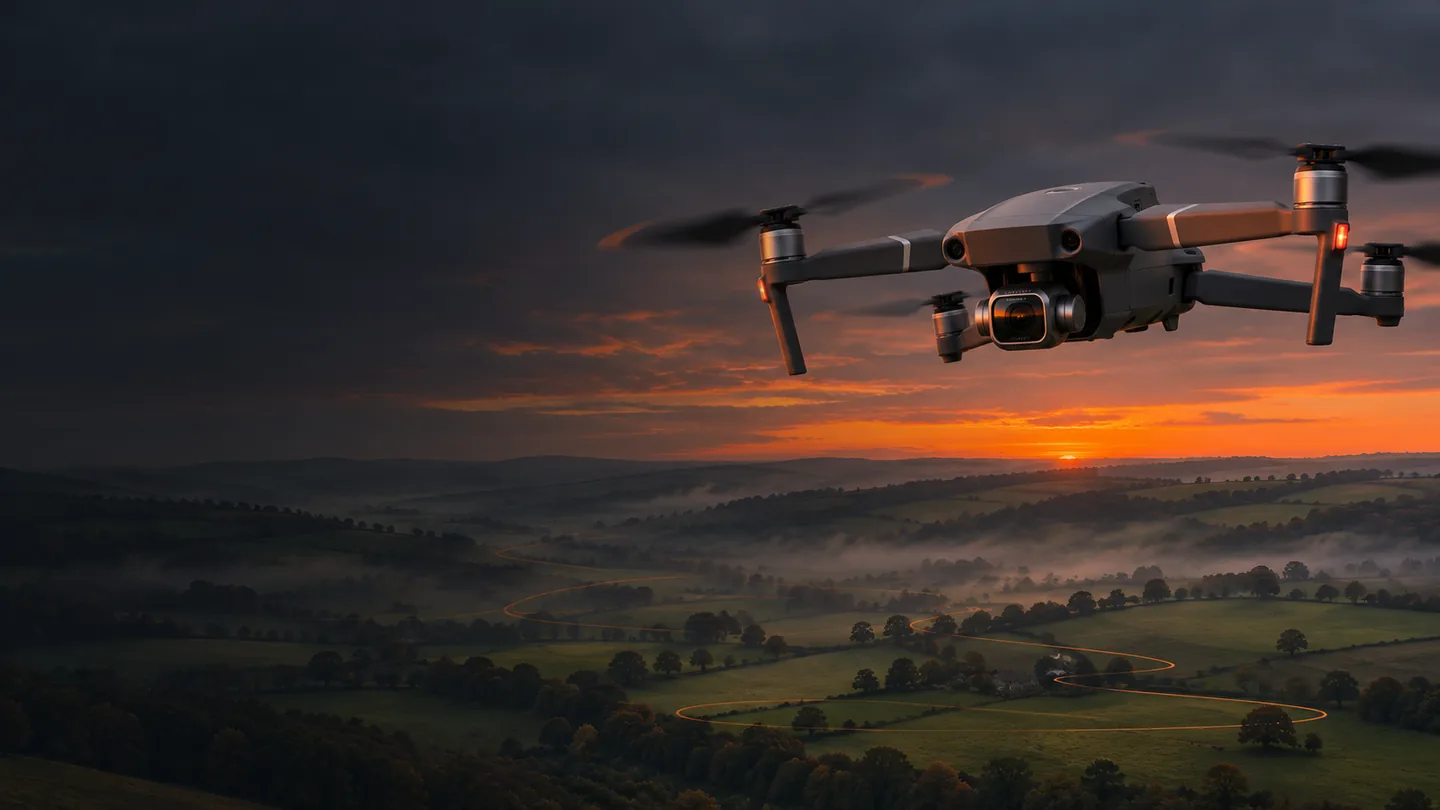
Watch the decisions being made. Then watch what they become. Real creators, real aircraft and a few important differences between their setups and yours.
These are independently published YouTube videos, credited to their creators. They complement the written guide; they are not a claim that every demonstrated app, aircraft or controller matches your Mavic 2 Pro and iPhone. The player loads only when you choose it, with a direct YouTube link available underneath.
FILM BY Shaun the Drone
How to use the New Litchi Hub & Set up Waypoint Mission
Follow the transition from a browser plan to an actual mission. Hub planning begins around 04:26, the location test at 13:00 and the mission flight at 15:33. Useful for seeing how a planned composition survives contact with the real landscape.
Published 1 June 2025. Execution uses Mini 3 Pro / Litchi Pilot. Study the planning and completed flight; do not copy its flight-app setup for Mavic 2 Pro / original iOS Litchi.
A classic cinematic waypoint tutorial and flight example. Look for the relationship between aircraft movement and the camera’s direction, then compare the pacing with your own storyboard.
Published 11 April 2022. The creator lists Mavic 2 Pro, Phantom 4 Pro and Litchi on iPad / Smart Controller. This predates the new Hub; its interface is historical, while the shot-planning ideas remain useful.
Litchi Mapping Missions Tutorial — From App Install to Mission Hub Planning
A mapping walkthrough connecting Hub planning with an actual photographic flight. Watch how a field becomes a sequence of parallel capture lines, then compare its image collection choices with the interval calculations in the workshop.
Published 15 August 2025. The demonstrated aircraft is Mini 4 Pro with the Android / Pilot workflow. It is an example of planning and capture, not proof of equivalent Mavic 2 iPhone settings.
A completed Staffordshire aerial film from the earlier archive. Study the warm light, the relationship of the building to its landscape and how the sequence establishes a sense of place.
Real archive footage, linked from the existing NIX film catalogue. No claim is made that this particular film used Litchi or was shot on the Mavic 2 Pro.
A local aerial record of flooding around Milford. It shows why an overhead perspective can make the scale of a landscape event easier to understand than a single ground-level view.
A completed film from the existing NIX archive. This is visual documentation, not a georeferenced orthomosaic, calibrated water-depth map or drainage survey.
Video titles, creator details and/or existing NIX catalogue records checked 19 November 2026. Third-party availability and embedding permissions can change. If a player is blocked by your browser or YouTube, use its Watch on YouTube link. Captions and playback controls are supplied by YouTube where the creator makes them available.
NIX FIELD NOTES
Watch the move, not just the view.
On the first viewing, enjoy the film. On the second, ask what the aircraft is doing and what the camera is doing. Does the horizon enter because the drone climbed, because the gimbal tilted, or both? Does the building move against the hills because of a sideways track? Does the apparent speed come from the foreground rather than a fast aircraft?
Pause at the start and end of a shot. Sketch those two frames, then describe the minimum movement needed to connect them. That exercise turns passive inspiration into a practical mission idea. The best move is often simpler than the first one you imagine.
For mapping videos, look beyond the grid. Were original stills captured? Was the overlap maintained? Are control points and independent checks shown? A satisfying animation of a model says little about its measured accuracy unless the workflow includes evidence.
NIX FIELD NOTES
Continue exploring the real NIX archive.
The Flight Lab sits inside a much larger collection of flights, photographs and local stories. Keep the technical lessons close to the real work: compare a planned move with footage, read the flight record where one is available, and build the next experiment from what actually happened.