
TWO PANELS.
ONE SOUTH-FACING ROOF.
My first deliberately small step into home solar.
NOW I’M LOOKING
UPWARDS.
I have spent plenty of time thinking about solar power for Vanilla, watching watts trickle into batteries and discovering that a bit of sunshine can become surprisingly addictive.
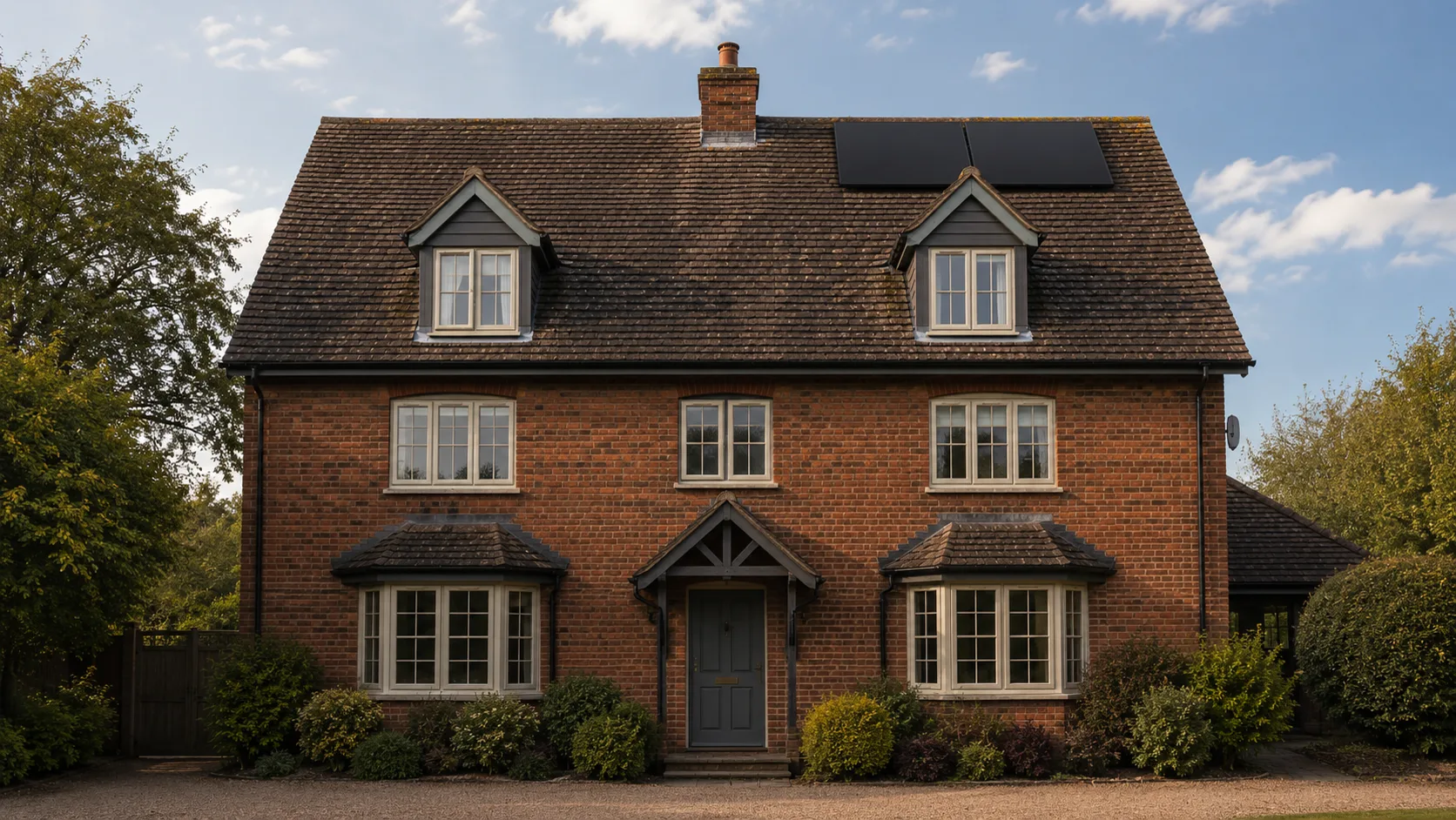
At home, there is something rather useful above the front door: a large south-facing roof. Rather than immediately covering the whole thing with panels, I started with a simpler question. What could I do with just two?
A SMALL ARRAY.
A PROPER EXPERIMENT.
The clear patch above the right-hand dormer looks large enough for a neat pair of modern all-black panels, mounted high enough to keep the layout deliberate and visually tidy. The exact position, clearances, loading and shading would need a professional roof survey; kerb appeal is not an engineering calculation.
SUNSHINE IN.
GRID USE DOWN.
The panels make DC electricity. A compliant microinverter converts it to 230V AC, allowing generation to serve loads in the house. If the home is using 500W while the array supplies 400W, roughly 100W still comes from the grid. There is no special solar socket for the fridge—the important bit is that the system and the home’s electrical installation are designed and approved to work safely together.
WHAT MIGHT
TWO PANELS DO?
My working estimate is around 700–850kWh a year for an 880–900W array with favourable orientation and limited shading. That is an estimate, not a quotation or yield guarantee. Roof angle, local shading, equipment losses, weather and the final layout all matter. The chart shows the expected seasonal shape, not a measured forecast for this roof.
THE TOP NUMBER
ISN’T THE WHOLE DAY.
Solar panels rarely sit at their laboratory rating for hours. Slightly more panel capacity than inverter output can help the system reach useful power earlier, stay productive later and work harder in imperfect conditions.
On exceptional bright spells, the inverter may clip the very top of the output. That small theoretical loss can be a reasonable trade for better production across ordinary Staffordshire days—subject, of course, to the equipment manufacturer’s approved limits.
POSITION BEATS
GUESSWORK.
The roof is not an uninterrupted solar playground. Shadows from the chimney and dormers will move as the sun crosses the sky. Panel-level power electronics can reduce the way local shading affects a small system, but they cannot turn shade into sunshine. Before installation, I would want the intended position modelled properly rather than merely choosing the patch that looks prettiest from the road.
“PLUG-IN” DOES NOT MEAN
PLUG IN AND HOPE.
CHECK THE HOUSE
Electrical Safety First advises having the home assessed before purchase. Existing wiring and protective devices may not be suitable for two-way energy flow or the DC residual current a microinverter can introduce.
CHECK THE SYSTEM
I would use reputable, compliant equipment with clear UK documentation, safe isolation, suitable mounting and competent installation—not an anonymous box whose principal qualification is free next-day delivery.
NOTIFY AND CONFIRM
The installer must establish the correct Distribution Network Operator notification route. Planning permission is often unnecessary for roof-mounted domestic panels in England when permitted-development limits are met, but listed buildings, conservation areas and other restrictions can change the answer.
SELF-CONSUMPTION
IS THE REAL NUMBER.
Generating 800kWh does not automatically avoid the retail price of 800kWh. Electricity is most valuable to me when the house uses it as it is generated.
Fridges, internet equipment, smart-home devices, Hue lighting, chargers and televisions all create a background load. My early £70–£110 annual-saving range is deliberately cautious and needs testing against real import prices and how much daytime generation I actually consume.
It is not going to finance a retirement to Monaco. But two quiet black rectangles nibbling away at the bill for 15 or 20 years has a certain appeal.
BECAUSE MAKING ELECTRICITY
IS APPARENTLY NOT ENOUGH.
I also need to know precisely how many watts the roof is producing while I am standing in Tesco. This will surprise absolutely nobody who knows NIX.
TWO PANELS.
MEASURE EVERYTHING.
Start with two. Watch what they generate. Measure what the house uses. Collect a year of proper data. Then decide whether a battery, a larger array or simply leaving a successful little system alone makes sense.
Vanilla taught me how much useful energy can be harvested from the sky. Now it might be time for NIX Solar to come home.