ZOOM — Why My DJI Mini 4 Pro Is the Little Drone That Changed Everything
From a pocket-sized flying camera to the everyday flagship of NIXDRONES, this is the story of Zoom, my DJI Mini 4 Pro. Orange propellers, glorious 4K footage, remarkable technology and the freedom to see the world differently.
NIXDRONES // SKY // THE HANGAR
ZOOM — THE LITTLE DRONE THAT CHANGED EVERYTHING
My DJI Mini 4 Pro. A tiny aircraft, a phenomenal camera, an extraordinary collection of technology and the drone that has become the everyday flagship of NIXDRONES.
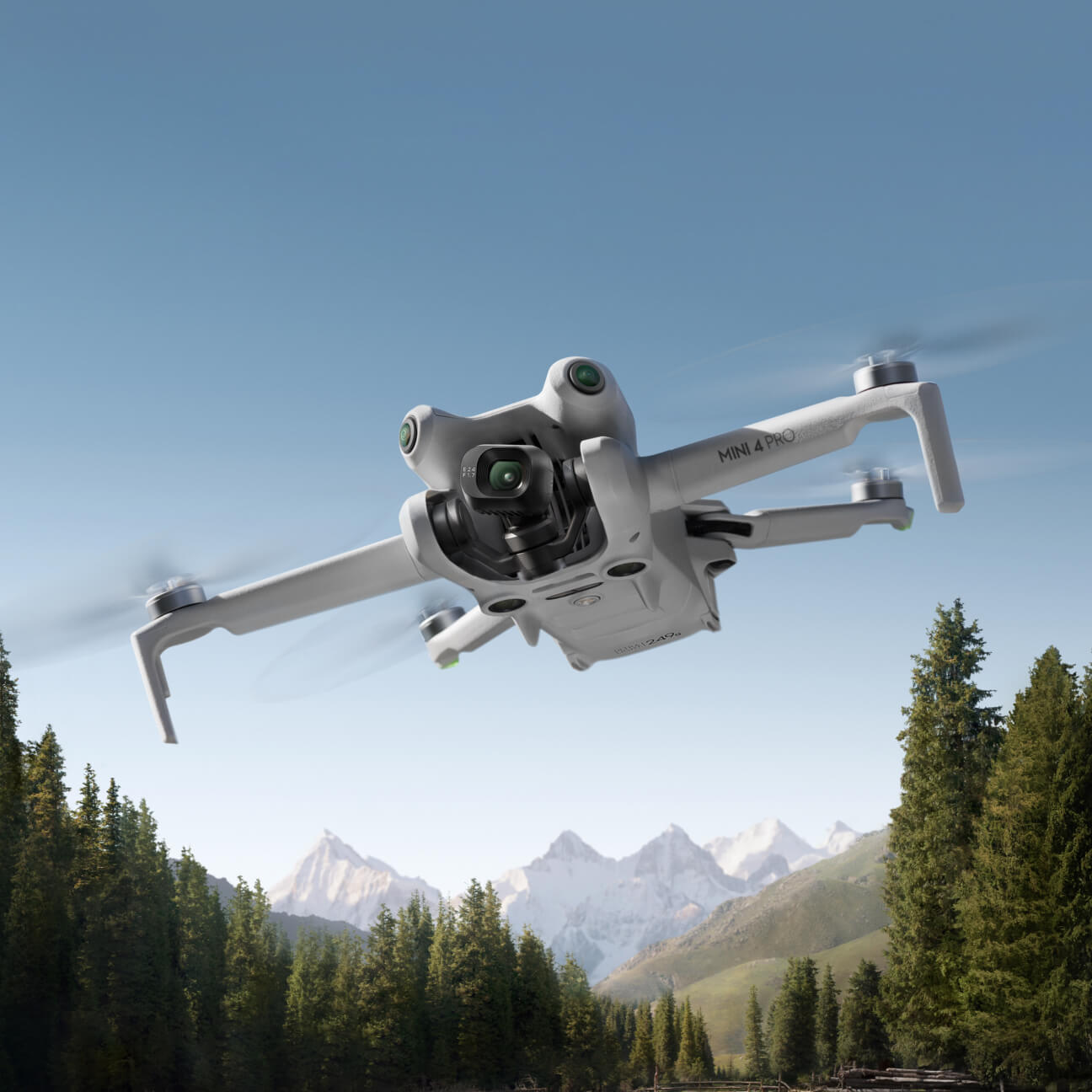
UNDER 249G / 48MP / 4K HDR / 10-BIT D-LOG M / ACTIVETRACK 360°
There is a particular moment that anyone who loves drone photography will recognise.
You arrive somewhere beautiful. Perhaps it is a quiet corner of Staffordshire, a remote beach, a mountain valley or an ordinary country road winding its way across an extraordinary landscape.
From where you are standing, the view is already impressive.
But you find yourself looking upwards.
And you start wondering what everything would look like from the sky.
That question is one of the reasons NIXDRONES exists.
I have always loved photography, and I have always loved technology. Put the two together, give them four propellers and the ability to fly, and I am very easily entertained.
Over the years, I have built up a collection of drones. Each has its own name, personality and reason for existing.
But there is one little aircraft that has become an almost perfect combination of convenience, image quality and astonishing technical sophistication.
Its name is ZOOM.
My DJI Mini 4 Pro.
It is not the biggest aircraft in the NIX fleet. It does not have the largest imaging sensor. Nor can it perform absolutely every trick possible with larger or more specialised drones.
What it does offer is arguably more valuable.
It makes wonderful aerial photography so accessible that there is very little reason to leave it behind.
And that changes everything.
01 // EVERY AIRCRAFT NEEDS A NAME
Zoom joined my collection on 28 May 2025.
It entered a fleet that already had plenty of history.
There is Nemesis, my DJI Mavic 2 Pro, a substantial aircraft with its excellent one-inch Hasselblad camera.
There is Twitch, my DJI Spark, representing a wonderfully interesting earlier generation of consumer drone technology.
And there is Sneaker, my DJI Neo 2, offering an entirely different approach to compact, action-oriented aerial filming.
Zoom has its own place among them.
It is the aircraft that combines serious photographic capability with the convenience of being small enough to take virtually anywhere that I might reasonably want to photograph.
Like my other aircraft, Zoom has the distinctive orange-propeller identity that has become part of NIXDRONES.
It might start life as a grey DJI product, but it belongs in an orange fleet.
The name suits it perfectly.
Not because I want to tear around the sky at ridiculous speeds, but because Zoom reduces the distance between seeing a photographic opportunity and actually capturing it.
See the light. Study the location. Check the conditions. Get the camera airborne.
Simple.
Well, relatively simple. There is still an astonishing amount of technology involved.
02 // SMALL IS A SUPERPOWER
Let's begin with one of the most extraordinary facts about the DJI Mini 4 Pro.
In its standard configuration, it weighs less than 249 grams.
Think about that for a moment.
This tiny machine contains four precision-controlled brushless motors, satellite navigation, sophisticated flight-control electronics, multiple obstacle-detection sensors, a stabilised camera gimbal, high-definition wireless communications and a camera capable of producing 48-megapixel photographs and 4K video.
And the whole thing weighs roughly as much as a substantial packet of biscuits.
Unlike the biscuits, it generally survives being taken on an adventure.
The aircraft folds down to approximately 148 × 94 × 64 millimetres without its propellers.
That makes it incredibly easy to transport.
It is one thing for a manufacturer to produce an impressive specification sheet. It is quite another to make a machine so convenient that you genuinely want to take it out and use it regularly.
That is where Zoom excels.
Its small size means I can take it on campervan journeys, photographic excursions and countryside walks without turning the whole day into a logistical operation.
Portability matters because opportunities cannot always be scheduled.
The cloud formation that looks beautiful at four o'clock might have disappeared by half past.
A misty morning can transform itself in minutes.
And a perfect sunset is not particularly interested in whether I remembered to bring a large equipment case.
The best camera is often the one I actually have with me.
Zoom makes that much more likely.

03 // THE CAMERA: 48 MILLION REASONS TO SMILE
Of course, the real reason I own drones is not simply to watch them flying.
I want the photographs and films they can produce.
Zoom uses a 1/1.3-inch CMOS imaging sensor capable of producing 48-megapixel still photographs.
Its fixed lens has a 24mm equivalent focal length and an f/1.7 aperture.
These figures might not mean much to someone unfamiliar with photography, but they are impressive for such a small aircraft.
A 24mm equivalent focal length gives a wide view, well suited to landscapes, coastlines, countryside and architecture.
The f/1.7 aperture helps the camera gather available light.
And the sensor offers enough detail for some extremely satisfying photographs.
But I would argue that the most interesting part is not the headline 48-megapixel resolution.
It is the flexibility.
12 megapixels or 48 megapixels?
The Mini 4 Pro provides both 12MP and 48MP still-photo modes.
The sensor uses a Quad Bayer arrangement, allowing different approaches to combining pixel information.
In good light, the 48MP mode can preserve a huge amount of scene detail.
That is useful for wide landscapes and photographs that might later be cropped or printed at a substantial size.
The 12MP mode can be advantageous in other conditions, including more difficult lighting.
It is worth understanding the differences rather than automatically selecting the highest number.
Forty-eight megapixels does not guarantee a better photograph.
It guarantees a larger image file.
Whether that file contains genuinely useful additional detail depends on the scene, light, exposure and processing.
Sometimes a well-exposed 12MP photograph will be exactly what is needed.
RAW photographs
Zoom supports DNG RAW photography.
This is particularly important to me because taking the photograph is only the beginning of the creative process.
RAW files preserve more editing flexibility than a finished JPEG, enabling careful adjustment of exposure, highlights, shadows, colour and contrast.
A sunset is an excellent example.
The sky might be extremely bright while the fields or buildings beneath it are already quite dark.
Getting the exposure right is essential, but a RAW file provides useful flexibility when developing the finished photograph.
I enjoy strong colour and atmosphere, but the picture still needs to look believable.
There is an art to making an image look beautiful without making it look as though someone has poured a bucket of orange paint over the entire countryside.
Even on NIXDRONES, there are limits to how much orange the world needs.
Exposure bracketing
The camera also offers automatic exposure bracketing.
This means recording several photographs using different exposures.
They can then be combined in suitable editing software when the difference between bright and dark areas is particularly challenging.
It is a traditional photographic technique adapted to a flying digital camera.
And that is one of the things I find most satisfying about modern photographic technology.
The fundamental ideas have not changed. We still think about exposure, composition, light and contrast.
What has changed is the extraordinary freedom with which we can apply them.
04 // PANORAMAS AND THE BIGGER PICTURE
Some landscapes are simply too big to fit comfortably into one conventional photograph.
This is where the Mini 4 Pro's panorama features become extremely useful.
Imagine photographing a wide valley.
There are hills on either side, a river curving through the middle and a road following the landscape towards the horizon.
A single wide photograph might capture the essentials.
But a carefully produced panorama can communicate the scale far more effectively.
The drone records multiple overlapping images and uses them to produce a wider composition.
Of course, panoramic photography introduces its own challenges.
Moving objects can create stitching problems. Changes in light can lead to uneven exposure. And an uninteresting composition remains uninteresting no matter how many photographs are combined.
Nevertheless, the creative possibilities are enormous.
One of my favourite things about aerial photography is the way roads, rivers and paths reveal their relationship to the surrounding landscape.
From ground level, you see a road.
From above, you see why that road takes the route it does.
Sometimes the camera becomes a tool for understanding geography as much as capturing beauty.
05 // A LITTLE FLYING CINEMA CAMERA
If Zoom were only a still camera, it would already be a remarkable piece of technology.
But its video capabilities take things much further.
The Mini 4 Pro records 4K video at up to 60 frames per second, including HDR recording in supported modes.
It also offers a dedicated 4K slow-motion recording mode at 100 frames per second.
And, importantly for more advanced editing, it supports 10-bit D-Log M and HLG colour profiles.
In the right hands, this is a genuinely capable miniature cinema camera.
For me, one of the most attractive possibilities is the slow reveal.
Imagine beginning a video with a line of trees filling the frame.
Zoom rises gently, its gimbal holding the camera steady.
Gradually, the trees drop lower in the image and an enormous valley appears behind them.
The movement is slow, controlled and deliberate.
The audience is given time to appreciate the scene.
That kind of sequence is far more interesting to me than simply flying around at maximum speed.
Beautiful aerial filmmaking is not about demonstrating how quickly a drone can move.
It is about deciding what the viewer should see, and then revealing it in the most effective way.
06 // WHY 10-BIT COLOUR MATTERS
I love the technical side of photography, so let's explore this in a little more detail.
Conventional 8-bit video provides 256 possible tonal levels for each colour channel.
Ten-bit video provides 1,024.
That is a substantial increase in the number of possible colour combinations.
In practical terms, it can provide smoother colour gradients and greater flexibility during colour grading.
Skies are a particularly useful example.
A beautiful evening sky can contain subtle transitions between blue, purple, pink and orange.
Recording and processing those transitions accurately can be challenging.
Ten-bit recording gives the editing process more tonal information to work with.
D-Log M is especially useful for footage intended to be colour graded.
The image can initially look relatively flat because it is designed for further processing rather than an immediately punchy appearance.
HLG provides another option for suitable HDR workflows.
Neither one is a magic button.
Bad exposure is still bad exposure. Poor composition remains poor composition.
But when the fundamentals are right, these tools can help produce some magnificent footage.
07 // THE THREE-AXIS GIMBAL
One of the most important components of any camera drone is also one of the easiest to overlook.
The gimbal.
Zoom's camera is mounted on a three-axis mechanical stabilisation system.
As the aircraft makes small adjustments to remain stable, the gimbal works to keep the camera movement controlled.
This is how a tiny aircraft buffeted by minor air movements can produce footage that looks as though it were recorded using a much larger camera platform.
It is an extraordinary piece of mechanical and electronic engineering.
For me, it also changes how I think about camera movement.
I can slowly tilt the camera downwards while the drone moves forward.
I can maintain a carefully framed subject while changing altitude.
Or I can hold a nearly static composition while the landscape gently moves beneath the aircraft.
Sometimes the most impressive technology is doing its best work when the viewer does not notice it at all.
08 // TRUE VERTICAL SHOOTING
Another clever feature is true vertical shooting.
Instead of recording widescreen video and cropping it later, Zoom can physically rotate its camera into a portrait orientation.
That makes a real difference when producing content for phones.
Think about a long road disappearing between fields, a waterfall descending from a cliff or a narrow forest track running towards the horizon.
Those scenes can look magnificent in a vertical composition.
And because the camera genuinely changes orientation, I can frame the shot properly from the beginning.
It is another reminder that the best way to make a photograph is to think about how it should look before pressing the button.
09 // OMNIDIRECTIONAL OBSTACLE SENSING
Perhaps the most reassuring technological improvement over some older drones is Zoom's obstacle-sensing system.
The Mini 4 Pro uses multiple vision sensors to detect obstacles in different directions, with an additional infrared sensing system beneath the aircraft.
This allows compatible flight-assistance functions to recognise many hazards and take action, depending on the selected settings and conditions.
It is an extremely clever system.
But it is not infallible.
Thin wires, small branches, reflective surfaces, poor light and difficult textures can all create problems.
And obstacle sensing cannot account for every possible movement of people, animals or other objects.
I regard it as an additional safety feature rather than a reason to become complacent.
The pilot still needs to understand the environment, maintain visual line of sight and anticipate hazards.
Much like advanced assistance technology in a modern vehicle, the clever electronics should support good judgement.
They should never replace it.
10 // ACTIVETRACK 360°
Now we get to one of the really entertaining features.
ActiveTrack 360° allows Zoom to follow a selected subject while using different camera positions and tracking movements.
For a person interested in campervan adventures, cycling and outdoor photography, the creative possibilities are obvious.
A carefully planned walking sequence through open countryside could look magnificent.
A slow tracking shot alongside a suitable path can make a small journey look cinematic.
And changing the camera position during movement can reveal the surrounding landscape in ways that would otherwise require a separate camera operator.
This is especially appealing to someone who often takes photographs and films independently.
But intelligent tracking needs to be treated intelligently.
The flight must remain legal and safe, the aircraft must remain within visual line of sight, and the surroundings need to be appropriate for automated movement.
In particular, the feature does not make it sensible to send the drone unsupervised after a bicycle through complicated woodland.
That might look spectacular in a promotional film, but trees and electronics can become very expensive acquaintances.
11 // WAYPOINT FLIGHT — THE GEEK'S DREAM
If I had to nominate one feature specifically designed to appeal to my inner technology enthusiast, Waypoint Flight would be near the top of the list.
Waypoint Flight lets the pilot build a flight route using planned positions and camera parameters.
Rather than improvising the entire filming movement, it becomes possible to design a sequence more deliberately.
For cinematic work, that is extremely useful.
A gradual move across a landscape might involve several carefully selected positions, altitudes, headings and gimbal angles.
Planning these beforehand can make the result smoother and more consistent.
But the really exciting possibility is repeat photography.
Imagine creating a project called FOUR SEASONS.
Choose a suitable Staffordshire location, obtain any required permissions and design a controlled aerial sequence.
Film it in spring when everything begins turning green.
Return in summer.
Repeat in autumn when the colours change.
Then capture a final winter sequence, perhaps with frost or snow covering the landscape.
Edited together, those sequences could become an extraordinary little film about the passage of time.
Waypoint Flight can help make that type of project more consistent.
It is still essential to check the route, obstacles, airspace and conditions each time. A previously safe route is not automatically safe forever.
But as a creative tool, the potential is enormous.
12 // MASTER SHOTS AND QUICK SHOTS
Not every aerial film needs hours of planning.
Sometimes I simply want an attractive sequence that captures the atmosphere of a location.
This is where DJI's automated filming modes can be particularly helpful.
MasterShots can perform a collection of camera movements designed to produce interesting footage of a subject or scene.
QuickShots provide other predefined movements.
Used properly, these can save time and help produce consistent results.
Of course, automation is not the same thing as creativity.
A complicated movement does not automatically produce an interesting film.
Sometimes a steady five-second shot tells the story better than an elaborate series of circles and climbs.
The trick is knowing when to use the technology, and when to keep things beautifully simple.
13 // THE ART OF THE AERIAL PHOTOGRAPH
This is the section that matters most to me.
The aircraft, specifications and technology are wonderful, but ultimately they only matter because of the images they make possible.
A good aerial photograph should do more than demonstrate that somebody owns a drone.
It should reveal something.
A pattern in the landscape.
The relationship between a winding road and the surrounding hills.
The symmetry of an interesting building.
The colours of woodland in autumn.
The movement of water along a coastline.
Or the wonderful isolation of a little campervan parked in an enormous landscape.
These are photographs that tell stories.
I particularly like the way an aerial perspective can make familiar places look completely different.
A field becomes a series of shapes.
A footpath becomes a line through a landscape.
A village reveals the pattern of its streets.
Even an ordinary road junction can become visually interesting when photographed from directly above.
That ability to reveal hidden patterns is perhaps the greatest gift drone photography has given me.
14 // GOOD LIGHT IS STILL EVERYTHING
There is a danger with modern photographic technology that we become obsessed with equipment.
How many megapixels? How much dynamic range? Which colour profile? How many intelligent flight modes?
They are interesting questions, and I enjoy investigating all of them.
But the fundamentals remain unchanged.
Good light makes good photography possible.
Early morning and late evening can transform a landscape.
When the sun is low, shadows lengthen and reveal the shape of the ground.
Woodland becomes richer and more atmospheric.
Buildings acquire greater depth.
Clouds can create enormous moving patches of sunlight and shade.
And a road that looked completely ordinary at lunchtime can suddenly become the centrepiece of a beautiful photograph.
That is why patience matters.
It is often worth waiting for the right conditions rather than launching immediately and trying to force a photograph to happen.
Aerial photography is not a race to empty the battery.
Sometimes the most productive part of a flight is the ten minutes spent beforehand deciding what the picture should actually look like.
15 // ZOOM AND VANILLA: A BRILLIANT COMBINATION
There is another very good reason Zoom suits my life so well.
Vanilla.
My Volkswagen T6.1 campervan has become the perfect companion for travelling, exploring and photography.
It gives me freedom, accommodation, somewhere to cook, somewhere to rest and an excellent base for my collection of photographic equipment.
Zoom fits naturally into that world.
I can take the drone on an adventure without it demanding a huge amount of space.
Vanilla provides somewhere to check the weather, review maps, examine airspace information and prepare equipment before going outside.
It is also somewhere comfortable to return after flying.
When the weather is poor, I can stay inside with a cup of tea and wait for a suitable opportunity.
That is much better than standing around in the rain hoping the wind will suddenly become cooperative.
The combination of campervan and camera drone creates an almost perfect approach to exploring.
Travel when the mood takes me.
Find somewhere interesting.
Spend time getting to know the location.
Wait for the light.
And if it is safe and legal to fly, capture the landscape from above.
For me, that is what adventure photography is all about.
16 // OFF-GRID POWER AND DRONE CHARGING
One of the most useful developments in Vanilla has been the evolution of its electrical system.
With a Fogstar 105Ah lithium leisure battery, Victron monitoring and charging equipment, a 200W solar panel and separate Jackery portable power stations, I have considerable flexibility when travelling away from conventional mains hook-up.
That makes keeping photographic equipment charged much easier.
The standard DJI Mini 4 Pro battery has a nominal energy capacity of approximately 18.96Wh.
In purely theoretical energy terms, a system holding a kilowatt-hour of usable electricity could replenish a substantial number of small drone batteries.
In practice, charging losses, conversion efficiency, other electrical loads and the actual available stored energy all need to be considered.
Nevertheless, a small drone battery is a relatively manageable load compared with the cooking and heating appliances that can dominate a campervan energy budget.
I particularly like the prospect of returning from a flight, recharging while I relax, and being ready for another photographic opportunity later in the day.
With solar energy available, the whole arrangement becomes even more satisfying.
Sunlight helps replenish the electrical system, which in turn supports a camera used to photograph the world beneath that same sunlight.
Rather pleasing, really.
17 // STAFFORDSHIRE FROM A DIFFERENT ANGLE
Living around Stafford means I have some excellent countryside within easy reach.
Cannock Chase is an obvious source of photographic inspiration.
Its mixture of woodland, heathland, tracks and changing seasonal colours provides enormous visual variety.
The nearby countryside also has countless roads, fields, villages and waterways that could make fascinating subjects.
But finding an attractive location is only the beginning.
A drone flight requires consideration of airspace, permissions, wildlife, people, restrictions and local conditions.
Protected landscapes and managed land can have specific rules about launching, landing and drone activity.
I would never assume that being in an attractive or apparently remote location automatically makes it suitable for flying.
Sometimes the best way to enjoy somewhere is to leave the drone in its bag and take photographs from the ground.
That is still a successful photographic outing.
For me, the important thing is being out there, noticing the landscape and discovering opportunities.
18 // FROM STAFFORDSHIRE TO EUROPE
One of the things I have always enjoyed about travelling is the extraordinary variety of landscapes across Europe.
A day spent driving across French countryside feels entirely different from a journey through the Alps or along the Mediterranean coast.
My campervan travels have already demonstrated just how much scenery can change over a relatively short distance.
Zoom is ideally suited to future photographic adventures of this kind.
Its small size makes packing simple, while its camera is capable of capturing an enormous range of subjects.
Imagine the vineyards of France, mountain roads in Austria, Spanish countryside or the contrast between cliffs and the blue Mediterranean.
Each presents a completely different visual problem to solve.
Of course, European drone regulations require proper preparation.
Registration, operator identification, geographic zones and local flight restrictions vary between countries and need checking before travelling and flying.
A familiar aircraft does not guarantee familiar regulations.
The responsible approach is to plan the flying as carefully as the photography.
19 // BATTERY LIFE: THE REAL WORLD
DJI quotes up to 34 minutes of flight time with the standard Intelligent Flight Battery under controlled test conditions.
That is an impressive result for an aircraft of this size.
But I would never plan a flight around the assumption that every battery will deliver exactly 34 minutes in every situation.
Temperature matters.
Wind matters.
Flight speed matters.
Climbing, descending, manoeuvring and hovering can all affect energy