# PANASONIC PN100: WHAT ON EARTH IS IT DOING IN THERE? 🍞⚙️
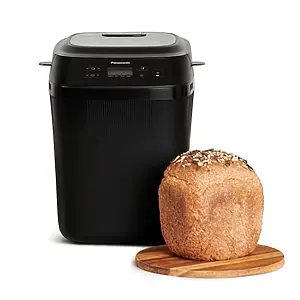
I absolutely love my little Panasonic PN100.
PANASONIC PN100: WHAT ON EARTH IS IT DOING IN THERE? 🍞⚙️
THE NIX PLAIN-ENGLISH GUIDE TO REST, KNEAD, RISE AND BAKE
I absolutely love my little Panasonic PN100.
It is compact, ridiculously easy to use once you understand it, and capable of producing a genuinely cracking little loaf without turning the kitchen into something resembling the aftermath of The Great British Bake Off.
But there is one slightly strange thing about owning one.
You put everything into the bread pan.
Press START.
And then...
nothing happens.
😐
No kneading.
No whirring.
No dramatic bread-related activity whatsoever.
For anyone new to Panasonic breadmakers, this can create a brief moment of:
“Have I broken it?”
The answer is almost certainly:
No.
The clever little black box is thinking.
And once you understand the stages the PN100 goes through, the whole machine suddenly makes much more sense.
So this is my simplified guide to what is actually happening inside my Panasonic SD-PN100.
No engineering degree required. 🍞
🍞 FIRST: THE PN100 ISN'T JUST A MIXER WITH A HEATER
This was the bit I didn't fully appreciate at first.
The Panasonic isn't simply programmed to:
mix → wait → cook.
It actually manages the bread-making process.
Panasonic gives the PN100 two temperature sensors which monitor conditions inside and outside the machine. It then adjusts parts of the programme accordingly.
That explains why some stages are shown as a range of times rather than one exact time.
Your loaf isn't necessarily following precisely the same timetable every day.
A chilly Stafford kitchen in January and a warm kitchen in July aren't the same environment.
The PN100 knows that.
Clever little bread-bin-with-a-brain. 🧠🍞
THE FOUR BIG STAGES
For a normal loaf, think of the process like this:
**REST → KNEAD → RISE → BAKE**
Or, translated into NIX English:
**GET READY → MAKE DOUGH → GROW → TURN INTO BREAD**
That really is the basic principle.
1️⃣ REST
“WHY ISN'T MY BREADMAKER DOING ANYTHING?”
This is probably the stage most likely to confuse a new owner.
You've loaded the ingredients.
You've selected the programme.
You've pressed START.
And...
Silence.
Don't panic.
REST is supposed to look boring.
On the standard Basic programme, Panasonic's programme chart gives the initial rest period as approximately 40 minutes to 1 hour 5 minutes.
That is a surprisingly big chunk of the programme.
But it isn't wasted time.
The machine is allowing the ingredients and temperatures to settle before the serious kneading begins.
Don't interfere.
Don't think:
“I'll give it a helping hand.”
Don't start stirring it with a spoon.
Don't keep restarting it.
Don't assume the kneading blade has fallen off.
And you generally don't need to keep opening the lid every five minutes to see whether the flour has moved.
It knows what it's doing.
☕ Make a cup of tea.
2️⃣ KNEAD
NOW THE PN100 WAKES UP
Eventually you'll hear it.
Whirr... stop... whirr... churn...
The kneading blade starts turning and the ingredients begin transforming into dough.
This is where flour, water, yeast, salt, butter and everything else start becoming one elastic mass.
On the standard Basic programme, the main kneading stage is around 25 minutes.
The PN100 doesn't necessarily run continuously like a food mixer.
It can:
- turn
- stop
- turn again
- pulse
- change rhythm
- pause briefly
That's normal.
Panasonic has designed the blade and the ribs inside the bread pan to imitate aspects of artisan kneading rather than simply spinning the dough around endlessly.
THIS IS THE BEST TIME TO CHECK YOUR DOUGH
If I'm experimenting with a new recipe, this is the stage I'm most interested in.
After the dough has been mixing for a while, I'll occasionally lift the lid and have a quick look.
I'm looking for something roughly like:
a soft, smooth, slightly tacky ball of dough.
Not soup.
Not dry rubble.
Not flour permanently stuck all around the walls.
But don't become obsessed with achieving a perfectly polished tennis ball either.
Bread dough is alive and slightly scruffy.
If I'm using one of my established NIX recipes, I generally leave it alone.
🍞 MY 250g RULE
For my own PN100 experiments I've decided to keep my breadmaker recipes to a maximum of:
**250g FLOUR**
That's my personal NIX rule rather than a Panasonic requirement.
It gives me a sensible small loaf, suits the compact nature of the PN100 and gives me plenty of room to experiment with milk loaves, French-style breads, seeded bread and whatever culinary lunacy occurs to me next.
😂
3️⃣ RISE
THIS IS WHERE THE MAGIC REALLY HAPPENS
After kneading, things go quiet again.
This time the machine isn't waiting to start.
It's waiting for the dough to grow.
The yeast produces gas inside the dough and the gluten network holds onto it.
The dough gets bigger.
Lighter.
Airier.
This is what ultimately creates the structure of the bread.
On Menu 1 Basic, Panasonic quotes roughly 1 hour 40 minutes to 2 hours 5 minutes for the rise stage.
That's a massive part of the four-hour programme.
And that's important.
GOOD BREAD TAKES TIME.
This is also why I don't automatically regard the Rapid programme as “better” simply because it's quicker.
Bread isn't downloading a software update.
Time is an ingredient.
🕰️🍞
During the rise period you may occasionally hear the machine operate briefly.
Don't automatically assume it has gone back to kneading and ruined everything.
Some bread programmes include small movements, dough handling or stages within the overall process.
The machine knows where it is in the programme.
🌡️ WHY DOES THE RISE TIME CHANGE?
Temperature.
Yeast behaves differently depending on its environment.
If conditions are warmer, fermentation behaves differently than when everything is colder.
That's one of the clever features of the Panasonic system.
The machine's sensors help it adjust the programme rather than blindly following exactly the same timings regardless of kitchen temperature.
So don't worry if today's loaf appears to spend slightly longer doing something than yesterday's.
That's not necessarily inconsistency.
It may actually be the machine compensating for the conditions.
4️⃣ BAKE 🔥
Eventually we reach the stage where dough becomes bread.
The heater comes on.
The temperature rises.
The loaf expands a little more initially, the structure firms up and then the crust starts developing.
On Menu 1 Basic, Panasonic gives approximately 40 to 50 minutes for baking.
This is also the stage where I strongly recommend:
LEAVE THE LID SHUT.
Earlier in the programme, having a very quick peek at dough consistency isn't the end of the world.
During baking?
Different story.
Every time that lid opens, you're dumping heat.
You've waited several hours.
Don't sabotage the operation in the final furlong because you desperately want to stare at a loaf.
😂
🏁 THEN IT BEEPS
When the programme finishes, the PN100 tells you.
This is the moment to remove the bread pan carefully because:
IT IS HOT.
Properly hot.
Use oven gloves.
Remove the loaf from the pan and get it onto a cooling rack.
And this brings us to perhaps the hardest bread-making instruction of them all.
🚨 DO NOT IMMEDIATELY ATTACK IT WITH A KNIFE
I know.
Fresh bread.
Fantastic smell.
Butter waiting nearby.
Human nature says:
**CUT IT OPEN IMMEDIATELY.**
Try not to.
😂
Bread is still settling internally after it leaves the machine.
Cutting into it immediately can leave the centre gummy and compressed.
Put it on a rack and give it some cooling time.
The crust will settle.
Steam escapes.
The crumb firms up.
Then go for it.
🧈🍞
⚡ WHAT ABOUT BASIC RAPID?
This is where the PN100 demonstrates just how much of ordinary breadmaking is about time.
The normal Basic programme takes approximately:
**4 HOURS TO 4 HOURS 10 MINUTES**
Basic Rapid cuts that to roughly:
**1 HOUR 55 MINUTES TO 2 HOURS 5 MINUTES**
Panasonic achieves this with a very different schedule. The long initial REST stage disappears, kneading changes to around 40 minutes, the rise is about 50 minutes and baking roughly 30 to 40 minutes.
So Rapid isn't simply:
“Normal mode but everything spins faster.”
It's a genuinely different bread-making schedule.
When would I use it?
When I suddenly realise:
**WE HAVE NO BREAD.**
And I'd like some reasonably soon.
But if I've got the time?
I'd generally use the normal programme and give the dough the time it deserves.
🌾 WHAT ABOUT WHOLE WHEAT?
Wholemeal flour behaves differently again.
It benefits from more hydration time and a different fermentation schedule.
That's why Panasonic's Whole Wheat programme takes around:
**5 HOURS**
The initial rest alone can be approximately 1 hour 5 minutes to 1 hour 45 minutes, followed by kneading, a long rise and about 45 minutes of baking.
So if you select Whole Wheat and your machine appears to have entered hibernation...
It hasn't.
Leave it alone.
😂
⏰ THE TIMER DOESN'T MEAN “WAIT THIS LONG BEFORE STARTING”
This is another useful thing to understand.
The PN100 has a timer of up to 13 hours.
Think of it primarily in terms of:
**WHEN DO I WANT MY BREAD READY?**
Rather than:
“When should the machine start?”
That's much easier.
If I'm preparing bread before bed, I'm interested in waking up to finished bread.
The machine works backwards from that.
And waking up to the smell of fresh bread is frankly one of the strongest arguments yet devised for civilisation.
🍞☕😂
🥜 WHAT ABOUT RAISINS, CHEESE, SEEDS AND OTHER EXTRAS?
Some PN100 programmes are specifically intended for adding extra ingredients.
The machine can beep to tell you when it's time to add things such as dried fruit or nuts. Panasonic's instructions note that ingredients are manually added at the designated beep on the appropriate programme.
That's important.
Some ingredients aren't ideal if they're battered around during the entire kneading process.
Add them when the programme tells you.
The breadmaker has already done the timing.
🥣 DOUGH PROGRAMMES ARE DIFFERENT
The PN100 isn't limited to complete baked loaves.
It can also make dough.
For example, Panasonic specifies Menu 12 Basic Dough for recipes such as cinnamon-roll dough.
In that situation the PN100 does the tedious bit:
mixing + kneading + dough development
Then you remove the dough.
Shape it.
Fill it.
Proof it if required.
And bake it separately.
This massively increases what the little machine can actually do.
Pizza.
Rolls.
Buns.
Cinnamon rolls.
Experimental NIX bakery creations.
Things could get dangerous. 😂
🔥 BAKE ONLY IS EXACTLY WHAT IT SOUNDS LIKE
The PN100 also has a Bake Only programme.
This means the machine acts basically as a small controlled bread-pan oven.
Panasonic lists Bake Only as Menu 17, adjustable from around 30 minutes to 1 hour 30 minutes.
It's useful for things where you've prepared the mixture separately and simply want the machine to bake it.
Panasonic itself uses Bake Only for recipes such as its small banana bread.
So not everything that comes out of the PN100 needs yeast or a traditional bread cycle.
🍞 THE NIX PN100 CHEAT SHEET
Here's the entire normal bread process reduced to one tiny guide:
💤 REST
Machine appears to be doing nothing.
It is preparing conditions for the dough.
Action required: None.
⚙️ KNEAD
Machine starts whirring and mixing.
Flour + liquid + yeast become dough.
Action required: Usually none.
If testing a new recipe, this is the useful stage to check dough consistency.
🎈 RISE
Everything goes quiet again.
Yeast is inflating the dough.
Action required: Leave it alone.
🔥 BAKE
Machine becomes hot and your kitchen starts smelling magnificent.
Dough becomes bread.
Action required: Keep your paws off the lid.
😂
🔔 END
Remove the loaf using oven gloves.
Tip it onto a cooling rack.
Try to demonstrate some self-control before slicing it.
🚫 FIVE THINGS I WOULDN'T DO
1. DON'T PANIC DURING REST
Silence does not mean failure.
2. DON'T CONSTANTLY OPEN THE LID
Especially during rising and baking.
3. DON'T KEEP ADDING FLOUR
Dough can look sticky early in kneading.
Give it time before making adjustments.
4. DON'T TREAT RAPID AS THE DEFAULT
It's brilliant when you need speed.
But the full programme gives bread more time to develop.
5. DON'T REMOVE THE LOAF AND LEAVE IT IN THE PAN
Get it onto a rack.
Otherwise trapped steam can soften the crust and make the bottom damp.
🍞 THE BIGGEST LESSON I'VE LEARNED
The PN100 makes much more sense when you stop thinking of it as an appliance that cooks bread.
It actually manages a miniature baking process.
It controls the sequence.
It measures temperature.
It rests the ingredients.
It develops the dough.
It allows fermentation.
It manages the rise.
Then, only after all that, it switches roles and becomes an oven.
That's why a loaf can take four or five hours.
For much of that time the PN100 isn't apparently doing very much.
But neither is dough sitting under a tea towel in a traditional bakery.
The important stuff is happening quietly.
🟠 NIX VERDICT
The Panasonic PN100 is one of those machines that becomes considerably better once you understand its behaviour.
At first:
**“WHY IS IT JUST SITTING THERE?”**
A few loaves later:
“Leave it alone. It's resting.”
😂
And that, really, is the secret.
Measure carefully.
Choose the correct programme.
Press START.
Trust the process.
And stop staring through the lid every thirty seconds.
I've become increasingly convinced that half of successful breadmaking is ingredients, temperature and fermentation.
The other half is simply having the discipline to leave the bloody thing alone.
🍞⚙️🧈☕🟠
**REST → KNEAD → RISE → BAKE → EAT.**
Now that is an instruction manual I can understand.